
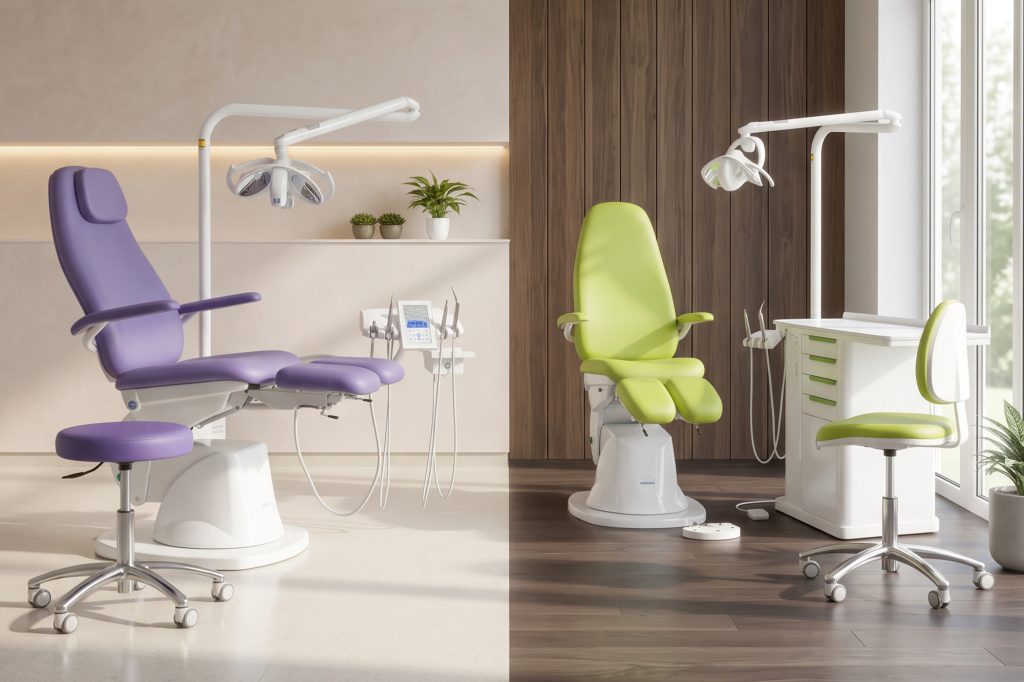
The podiatry unit houses many of the tools used during a consultation: micromotor, handpiece, suction system, syringe, spray systems, trays, and controls.
When equipping a clinic, one of the most important decisions is choosing between a standalone unit—installed as a separate module—and a unit that is integrated into or attached to the chair.
Both solutions can offer excellent performance. The choice depends primarily on available space, the practitioner’s working style, the number of instruments, and the potential for modifying the clinic’s layout in the future.
What is an independent podiatry unit?
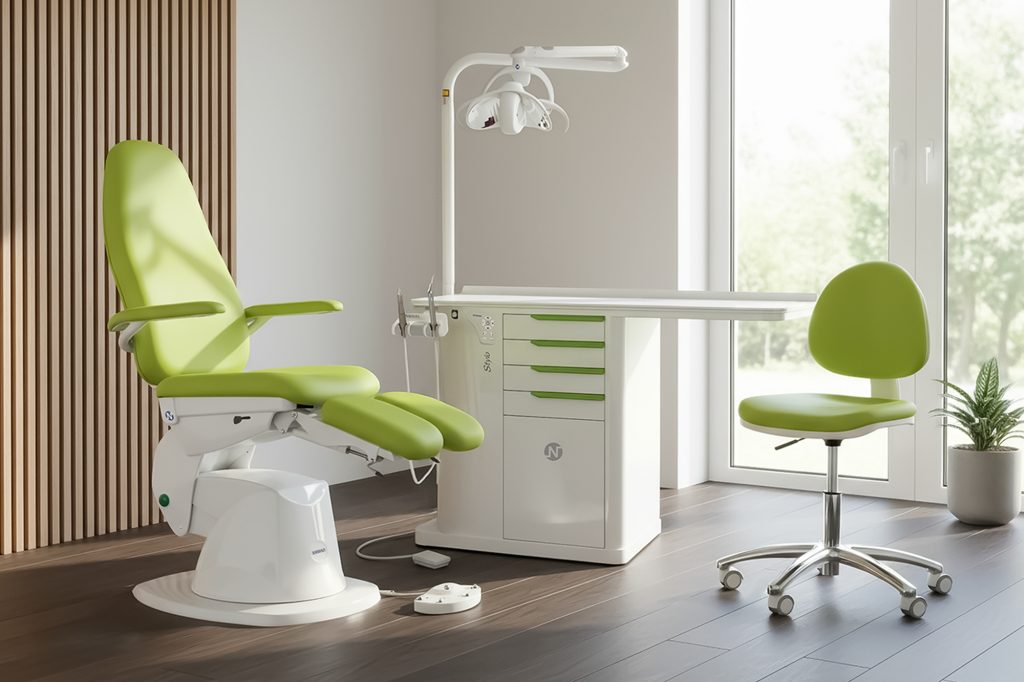
A standalone unit is a piece of equipment installed next to the dental chair but not structurally integrated into it.
It typically features wheels or its own base and may include:
- Instrument console.
- Micromotor.
- Handpiece.
- Suction system.
- Three-way syringe.
- Spray system.
- Foot control.
- Drawers and storage areas.
- Work surface.
- Compressor or connection to an external compressor.
Models such as Futura Plus, Futura XL, Stylo, Máxima, Duna, and Activ represent various standalone unit concepts and offer different storage and configuration capabilities.
Advantages of a standalone unit
Greater storage capacity
A unit with drawers allows burs, consumables, instruments, and accessories to be kept close to the work area.
This feature is particularly useful in practices with high patient volumes or a wide range of treatments.
Configuration flexibility
The unit and the chair can be selected separately. This allows the professional to combine the chair best suited to their patients with the unit offering the right number of instruments and drawers.
It also allows for upgrading one component without necessarily replacing the entire system.
Additional work surface
Some units feature a spacious countertop that can be used to prepare instruments or place small accessories.
On certain models, the surface features a bacteriostatic treatment or is designed for easy cleaning.
Greater independence from the chair
A standalone unit can remain operational even if the chair is replaced in the future, provided the installation and connections are compatible.
This can facilitate the gradual expansion or renovation of the clinic.
Possible limitations of a standalone unit
The main drawback is usually the space required.
In addition to the area needed for the dental chair, space must be allocated for the unit itself, ensuring that the arm, console, or drawers can be used without obstruction.
Proper planning is also essential for:
- Cable routing.
- Electrical connections.
- Air lines.
- Suction systems.
- Compressor placement.
- The practitioner’s movement around the chair.
A poor layout can make a fully equipped unit uncomfortable to use in a small practice.
What is a chair-integrated unit?
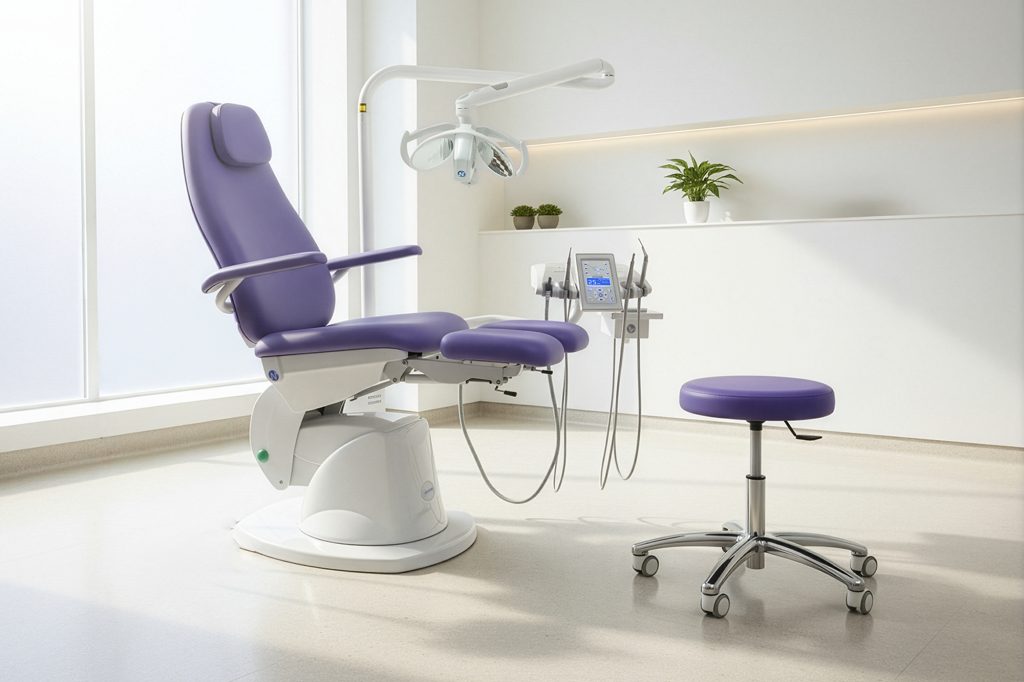
An integrated unit is mounted directly onto the chair or attached to it via an arm and mounting system.
The console and instruments move around the patient on an articulated arm. This design saves floor space and ensures the unit moves in coordination with the treatment area.
Namrol’s Epsylon and Epsylon Plus units are designed for installation on compatible chairs. They feature an ergonomic arm, an instrument console, a tray, controls, and a multifunction foot pedal.
Advantages of an integrated unit
Space optimization
Since it does not require a large, standalone cabinet, it can be a suitable option for compact treatment rooms.
The freed-up space can be used for an auxiliary drawer unit or a suction system, or to improve movement around the dental chair.
Instruments close to the treatment area
The articulated arm allows the console to be positioned close to the patient. This can reduce the need to move around and facilitate access to the micromotor, syringe, or suction system.
Cohesive look
The chair and the unit form an integrated workstation. Visually, the treatment room can appear cleaner and more compact.
Control from a single area
Depending on the model, the panel can control both the instruments and specific chair movements.
This integration makes it easier to use various functions during the appointment.
Possible limitations of an integrated unit
The primary consideration is compatibility.
Not all units can be installed on every dental chair. It is necessary to check:
- Chair model.
- Number of motors.
- Mounting system.
- Control box.
- Year of manufacture.
- Electrical capacity.
- Panel and foot pedal compatibility.
It should also be noted that an integrated unit typically offers less storage capacity than a standalone cabinet. An auxiliary drawer unit may be required to store consumables and instruments.
Which one is better for a small clinic?
In a clinic with limited space, an integrated unit can help reduce the amount of furniture surrounding the dental chair.
However, before choosing one, it is advisable to consider where the following items will be stored:
- Burs.
- Gloves.
- Consumables.
- Cleaning products.
- Sterilized instruments.
- Frequently used spare parts.
A compact unit with drawers can also work well in a small space, provided its placement is properly planned.
Therefore, one should not evaluate the equipment size in isolation, but rather the entire treatment room setup.
Which one is better for a high-volume clinic?
A standalone unit with more drawers and a spacious countertop can be practical when treating a high volume of patients.
Having instruments and consumables close to the work area helps reduce interruptions and movement.
Models with extended modules or dual configurations allow for increased storage and better organization of materials.
Questions worth answering before choosing
Before making a decision, it may be helpful to consider the following questions:
- How much free space is there around the dental chair?
- How many instruments are typically used?
- Are one or more micromotors required?
- Is it necessary to work with spray?
- Where will the suction system and compressor be installed?
- How many drawers are needed?
- Might the clinic’s layout change in the future?
- Will a single practitioner be working, or several?
- Should the equipment be ready for future expansion?
- Is the installation intended for a right-handed or left-handed practitioner?
The importance of studying the workflow
The best equipment is not necessarily the one with the most features. It is the one that allows for work with minimal movement, keeps instruments organized, and facilitates easy cleaning.
Before finalizing the configuration, it is advisable to map out the treatment room layout and identify:
- Patient entry point.
- Circulation area.
- Practitioner’s position.
- Leg rest movement.
- Light arm range of motion.
- Drawer opening clearance.
- Foot pedal access.
- Clean and used instrument zones.
This planning can prevent issues that might not be apparent when viewing the equipment in isolation.
A standalone unit offers storage capacity, flexibility, and a spacious work surface. An integrated unit stands out for its compact size, direct access to instruments, and seamless integration with the dental chair.
The choice should be based on available space, the types of treatments performed, and the practitioner’s workflow. Analyzing the workflow prior to purchase allows for a treatment room setup that is more comfortable, organized, and ready for future growth.


