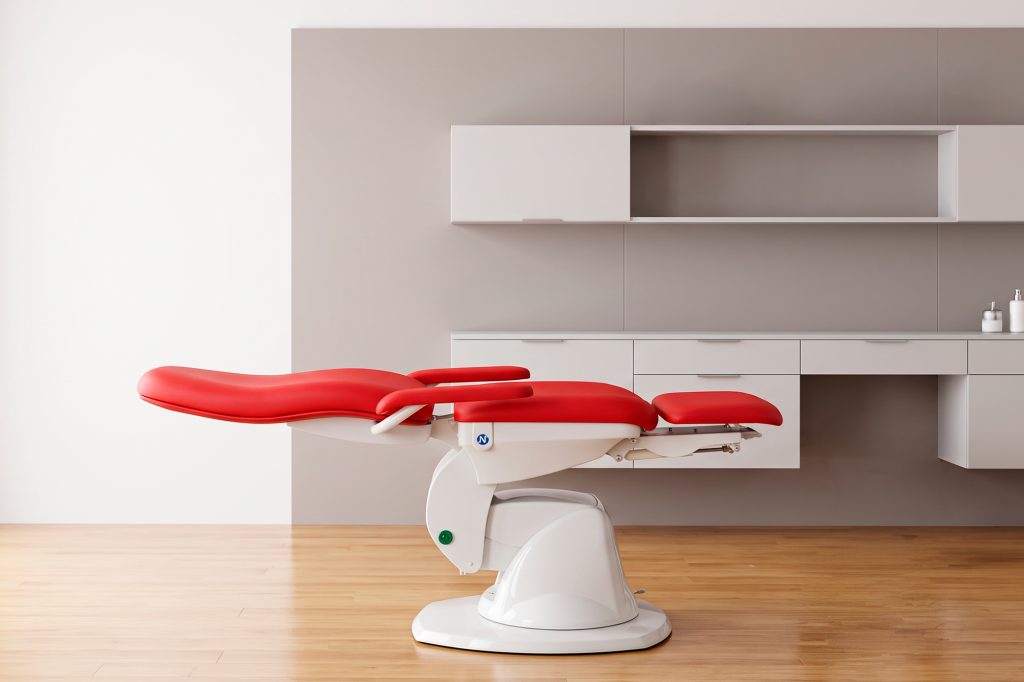
Patient positioning directly influences comfort, access to the foot and practitioner ergonomics. For this reason, the Trendelenburg movement is one of the most valued features in a podiatry chair.
Although the term is also used in other healthcare settings, in a podiatry clinic it mainly refers to the ability to tilt the seat electrically, changing the position of the patient’s body in relation to the floor.
What does the Trendelenburg position involve?
Generally speaking, the Trendelenburg position involves tilting the body so that the pelvis is positioned higher than the head.
In podiatry chairs, this inclination is achieved by tilting the seat. Depending on the model, the movement may be performed independently or synchronised with other chair adjustments.
This function makes it possible to adapt the patient’s position to the requirements of the treatment and bring the working area closer to the practitioner, reducing the need to lean excessively forwards.
Why is the Trendelenburg position useful in podiatry?
The Trendelenburg position can provide several benefits during everyday clinical work.
It facilitates access to the foot
Tilting the seat can place the lower limbs in a more favourable position for the practitioner, making it easier to observe and access different areas of the foot.
This adjustment is particularly useful when combined with:
Chair height adjustment.
Backrest inclination.
Extendable leg rests.
Lateral opening of the leg rests.
Headrest adjustment.
Combining these movements makes it possible to create a working position suited to each patient and procedure.
It reduces strained working postures
Maintaining an unsuitable posture throughout several appointments can cause strain in the back, neck, shoulders and wrists.
Tilting the seat helps position the foot within a more accessible working area. This allows the podiatrist to keep their back straighter, move closer to the patient correctly and avoid unnecessary movements.
A podiatry chair should not be adjusted solely for the patient’s comfort. It should also enable the practitioner to work in a stable and natural posture.
It improves positioning for different patients
Patients differ in height, mobility and body type. A single working position is therefore not suitable for every appointment.
The Trendelenburg movement allows the chair to be adapted to patients with different needs, especially when combined with extendable leg rests, folding armrests and electric backrest adjustment.
How does the number of motors affect chair adjustment?
The number of motors determines how many movements can be controlled electrically.
A single-motor chair usually provides electric height adjustment, while other settings are controlled manually or using gas springs.
Chairs with two or more motors progressively incorporate electric movements such as:
Height adjustment.
Trendelenburg movement.
Backrest adjustment.
Leg-rest movement.
Independent adjustment of each leg.
The right configuration depends on the treatments performed, the number of patients seen and the level of automation required by the practitioner.
Namrol offers chairs with different configurations, ranging from functional single-motor solutions to five-motor models with independent electric adjustment of each leg rest. Some models also include programmable working positions, automatic return to zero, rotation and safety systems.
How can you find a suitable working position?
There is no single configuration suitable for every procedure, but several basic principles can be followed:
Adjust the chair height first.
Position the foot within the practitioner’s field of vision.
Adjust the seat inclination.
Position the backrest so that the patient remains comfortable.
Extend or open the leg rests according to the area being treated.
Position the lamp to prevent shadows.
Check that all instruments are within comfortable reach.
The practitioner should be able to work without raising their shoulders, bending their back excessively or keeping their neck rotated for extended periods.
Why is it important to test the chair?
Before choosing a podiatry chair, it is advisable to test its movements in person.
The speed, smoothness, range of movement and ease of use can be just as important as the number of motors. It is also worth assessing the operation of the foot control, position memories, automatic return to zero and the overall stability of the chair.
A suitable podiatry chair is not simply one that offers numerous functions, but one that allows those functions to be used naturally throughout the working day.
The Trendelenburg position makes it easier to adapt the chair to the patient and bring the treatment area closer to the practitioner. Its main value in a podiatry clinic is that it supports a more accessible, stable and ergonomic working position.
Choosing between a compensated system and independent electric adjustment will depend on the requirements of each clinic. In either case, the correct combination of height, seat inclination, backrest and leg-rest adjustments can make a significant difference to everyday clinical work.